|
W o m e n |
|
|
November/December 2006
|
|
|
First female space tourist longs to head back to stars Womenone.org
STAR CITY, Russia - After fulfilling a childhood dream -- for a 25-million-dollar pricetag -- the world?s first female space tourist said Monday she would seize any chance to one day return to the stars. Anousheh Returns to Earth
World’s first female private space explorer completes historic spaceflight Space Adventures, Ltd., the world's leading space experiences company, announced today (September 28) that Anousheh Ansari successfully landed in the Kazakhstan steppes after an eight-day visit to the International Space Station (ISS). Mrs. Ansari returned to Earth aboard Soyuz TMA-8 with members of the Expedition 13 crew Jeff Williams and Pavel Vinogradov, who were relieved after their six-month assignment aboard the ISS. Please
click to read more and to see pictures. BBC
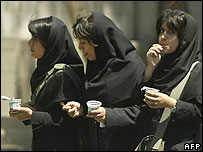
The number of women graduating from Iran's universities is overtaking the number of men, promising a change in the job market and, with it, profound social change. In some subjects 70% of Iran's graduates are women . Twenty postgraduate students are sitting in a plush modern classroom listening to a lecture on environmental management at the Islamic Azad University - a private institution with 1.6 million students across Iran. Shirin Neshat wins Gish Prize
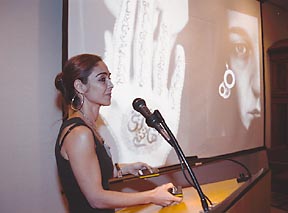
Iranian-born artist Shirin Neshat has won the 2006 Dorothy and Lillian Gish Prize, one of the largest and most prestigious awards in the arts. Neshat will receive a silver medallion and $300,000 at an awards ceremony on Oct. 12 in New York City. Neshat left her native Iran in 1979, just before the fall of the shah and the Islamic revolution. She has drawn on her own experience of exile for her work, which utilizes both still photography and film. After earning her art degree at UC Berkeley, she moved to New York, where she now resides. Because much of her work examines gender roles in Islamic society, it is considered so controversial in Iran that she has been forbidden to enter the country since 1996. She first became known for a series of photographs, "Women of Allah" (1993-97), in which she depicts veiled women carrying guns. Their skin is covered with Islamic verses. "In art, one is able to untangle complicated ideologies, demystify group and self identity, observe humanity and interpret memory," Neshat has said. "Issues that cannot be solved on the political stage might somehow find workable solutions when condensed into a work of art," she added. "This prize is an important acknowledgment of the power of art." The Dorothy and Lillian Gish Prize -- named for the famous American actresses of stage and screen -- is one of the largest awards in the arts and is given annually to "a man or woman who has made an outstanding contribution to the beauty of the world and to mankind's enjoyment and understanding of life." Previous winners include Ingmar Bergman, Bob Dylan, Merce Cunningham, Isabelle Allende, Robert Wilson, Frank Gehry, Bill T. Jones, Peter Sellars and Ornette Coleman. Before
she died in 1993, at age 100, Lillian Gish said: "It is my desire,
by establishing this prize, to give recipients of the prize the recognition
they deserve, to bring attention to their contributions to society
and encourage others to follow in their path."
Iranian women's campaign for 1 Million Signature Iranian women’s rights activists are initiating a wide campaign demanding an end to discriminatory laws against women in the Iranian law. The Campaign “One Million Signatures Demanding Changes to Discriminatory Laws” is a follow-up effort to the peaceful protest of the same aim, which took place on June 12, 2006 in Haft-e Tir Square in Tehran Women at risk of stoning Amnesty International identifies following women at risk of execution by stoning in Iran:
Parisa was arrested in April 2004, while working as a prostitute in the city of Shiraz in southern Iran. She confessed to the charge of adultery during the preliminary investigations, claiming that she had been forced into prostitution by her husband due to the family's poverty. Her trial took place in June 2004, during which Parisa retracted her confession. Nevertheless, on 21 June 2004, Branch 5 of Fars province Criminal Court sentenced her to death by stoning for adultery. The sentence was upheld by Branch 32 of the Supreme Court on 15 November 2005. Her case is currently being reviewed by the Supreme Court. Parisa is detained in Adelabad prison in Shiraz. Iran, an Ahwazi Arab from the Bakhtiari clan, was reportedly talking to the son of a neighbour in the courtyard of her house, when her husband attacked her with a knife. She was badly beaten and left bleeding and unconscious on the floor. While she was unconscious, it is alleged that the man killed her husband with his own knife. While police were interrogating her about the killing, Iran reportedly confessed to adultery with the son of her neighbour. However she later retracted her confession. A court in a city in Khuzestan sentenced her to five years' imprisonment for being an accomplice in the murder of her husband, and to execution by stoning for adultery. The verdict was upheld by the Supreme Court in April 2006. Her lawyer has appealed against the sentence. She is detained in Sepidar prison, in Ahvaz city. Khayrieh, an Ahwazi Arab, was reportedly subjected to domestic violence by her husband. She allegedly began an affair with a relative of her husband, who then murdered him. She was sentenced to death by Branch 3 of Behbahan Court, in Khuzestan in southwestern Iran, for being an accomplice in the murder of her husband, and death by stoning for adultery. Khayrieh has denied any involvement in her husband's murder, but confessed to adultery. The sentence was upheld, and the case has reportedly been sent to the Head of the Judiciary for permission to be implemented. Talking about her fate, Khayrieh said "I am ready to be hanged, but they should not stone me. They could strangle you and you would die, but it is very difficult to have stones hitting you in the head". Shamameh Ghorbani (also known as Malek), arrested in June 2005, was sentenced to execution by stoning for adultery by a court in Oromieh in June 2006. She is reportedly held in Oromieh prison. Her brothers and husband reportedly murdered a man that they found in her house, and she too was nearly killed after they stabbed her with a knife. Shamameh Ghorbani's case is reportedly being re-examined. Kobra Najjar, who is detained in Tabriz prison in northwestern Iran, is at imminent risk of execution. She was sentenced to eight years' imprisonment for being an accomplice to the murder of her husband, and execution by stoning for adultery. She was scheduled to be executed after serving her prison sentence, which was finished two years ago. She has reportedly written to the Judicial Commission for Amnesty to ask for her sentence of execution by stoning to be commuted, and is awaiting a reply. Kobra Najjar was allegedly forced into prostitution by her husband, a heroin addict who was violent towards her. In 1995, after a severe beating by her husband, she told one of her regular customers that she wanted to kill her husband. The customer allegedly murdered her husband after Kobra Najjar took him to an arranged meeting place. He was sentenced to death, but he was pardoned by the victim's family, to whom he paid diyeh (blood money). Soghra Mola'i was sentenced to 15 years' imprisonment for being an accomplice to the murder in January 2004 of her husband Abdollah, and to execution by stoning for adultery. During interrogation she said "My husband usually tormented me. Nevertheless, I did not intend to kill him. On the night of the incident … after Alireza killed my husband, I ran away with him because I was scared to stay at home, thinking that my brothers-in-law would kill me." Alireza was sentenced to death for the murder of Soghra Mola'i's husband, and to 100 lashes for "illicit relations". The sentences are pending examination by the Supreme Court. It is believed that Soghra Mola'i is detained in Reja'i Shahr prison, Karaj, near Tehran. In May 2005, Branch 71 of the Tehran Province Criminal Court sentenced Fatemeh (surname unknown) to retribution (qesas) for being an accomplice to murder, and execution by stoning for having an 'illicit relationship' with a man named Mahmoud. Her husband was sentenced to 16 years' imprisonment for being an accomplice to the murder of Mahmoud. The case is currently being examined in the Supreme Court. According to a May 2005 report in the newspaper Etemad, an altercation occurred between Mahmoud, and Fatemeh's husband. Fatemeh confessed to tying a rope around Mahmoud's throat, which resulted in his strangulation. She has claimed that she intended merely to tie his hands and feet after he was unconscious and hand him over to the police. BACKGROUND INFORMATION Amnesty International is aware of two other women under sentence of execution by stoning in Iran, Ashraf Kalhori (see UA 203/06, MDE 13/083/2006, 27 July 2006; and updates), and Hajieh Esmailvand (see UA 336/04, MDE 13/053/2004, 16 December 2004; and updates). The Head of the Judiciary announced a moratorium on the use of stoning in December 2002, but reports indicate a man and a woman may have been stoned to death in May 2006. RECOMMENDED ACTION: Please send appeals to arrive as quickly as possible, in Persian, English, Arabic or your own language: - calling for the sentences of execution by stoning of the seven women named above (naming them) to be commuted immediately; - stating your unconditional opposition to the death penalty, as the ultimate cruel, inhuman and degrading punishment and violation of the right to life; - reminding the Iranian authorities that the UN Human Rights Committee (in the case of Toonen v Australia) has made clear that treating adultery and fornication as criminal offences does not comply with international human rights standards. Therefore the sentence of execution by stoning for adultery breaches Iran's commitment under article 6(2) of the International Covenant on Civil and Political Rights that death sentences will be imposed "only for the most serious crimes"; - calling for the abolition of execution by stoning in Iran as a positive step towards implementing international law and standards for the protection of human rights.
Maria Khorsand President Ericsson Technology Licensing
|
|