|
|
|
September/October 2004
|
|
|
|
September/October 2004
|
|
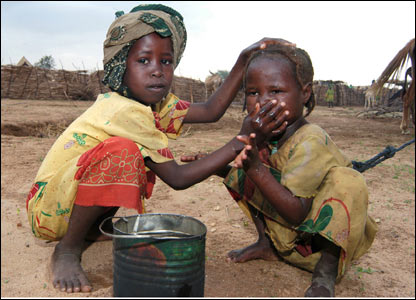
Sudan: Morning bath
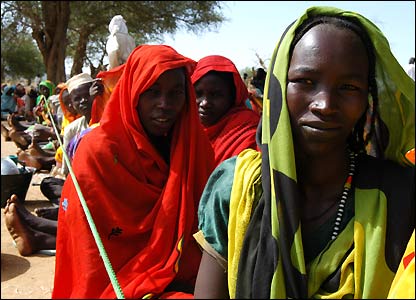
Sudanese refugee children seven-year-old Guisama Djamal Ibrahim and three-year-old Araba Djamal Ibrahim take an early morning wash in Bredjing camp. 'In front of my eyes' Eighteen-year-old Hawa Adam Aboullaye sits in a food
queue. She described how her village was attacked. ?We started to run but some soldiers? shot my father and my brother in front of my eyes. ?My father was still alive, so my husband picked him
and ran into the bush, but my father did not survive. My aunt was
also killed.?
Chili
America
Why
being funny is a serious
business in American campaign
Being funny has not always been a pre-requisite for being president - and indeed some of the funniest candidates in the history of US presidential campaigns have fallen before reaching the White House door. But in an age where the electorate no longer put politicians on the pedestals they once occupied, a joke is a crucial weapon when it comes to convincing voters that the candidate could live next door. Aspiring president John Kerry is likely to be giving humour some very serious thought as he prepares to be beamed into homes across America on Thursday, delivering what is billed as the most important speech of his campaign at the Democratic convention. "People still have to get to know Kerry," says Kenneth Baer, who wrote speeches for the last Democratic candidate Al Gore. "So jokes are really very important to him - humour is what will help people relate to him, and that's what he needs them to do now." |
Funnyman The rather aristocratic Mr Kerry - who is having to counter the allegation that he is aloof and lacking in charisma - may have particular need of a humour consultant to convince voters that he is just a regular guy. You know, John Edwards and I have a lot in common. His name is John, my name is John. He's a lawyer, I'm a lawyer. He was chosen 'the sexiest politician' by People Magazine. I read People Magazine John Kerry But George W Bush, whose problem is seen as more one of goofiness than aloofness, also employs a joke writer - a character who has in recent decades become an integral figure in most political campaigns, and a crucial sidekick if their jokes help win office. Ronald Reagan's joke writer dates the advent of strategic presidential humour back to, perhaps unsurprisingly, Ronald Reagan.
"He set a standard that presidential candidates since have struggled to emulate - they've all had joke writers since." Reagan's jokes On his work ethic: On the deficit:
The fact that the comedy show has become a political rite of passage may also have fuelled the phenomenon; recent research suggests these programmes have begun to rival main news outlet as a source of information for young people.
And while he managed to ridicule his younger opponent Walter Mondale when the issue of age came up in a 1984 debate with the line: "I am not going to exploit for political purposes my opponent's youth and inexperience", he tended to avoid mean jokes. He wrote a book at Yale, I read one George Bush Bob Dole's clever dry wit - rather than being an advantage in the 1996 campaign against Bill Clinton - was ultimately a little too cutting. "You shouldn't do mean," says Mr Gamble. "Unless you can make it look soft and playful, it doesn't work." Indeed an alleged off-the-cuff, cutting remark by Mr Kerry shortly after Mr Bush fell off his bicycle earlier this year was quickly deemed off-the-record. "Did the training wheels fall off?" he reportedly quipped. "Self-deprecation is by far the best option," agrees Mr Baer. Stealing thunder It is certainly the one that George W Bush has opted for. Following in Ronald Reagan's footsteps, he has sought to steal his opponent's thunder by poking fun at his own anti-intellectualism, noting once of a prestigious fellow student at his alma mater: "He wrote a book at Yale, I read one," and of his perceived laziness: "I've seen how things can work out pretty well for a C student." His occasional failure to grasp grammar, his articulation and sometimes curious choice of words have also been the butt of his own jokes. On meeting a Denver hockey player from the Czech Republic, he joked: "He uses unique English to confuse the opponents. Kind of sounds like the strategy I use at the press conferences." But stealing your opponent's tirades and making a joke out of them can backfire, as Mr Bush learned earlier this year while making fun of the fact that no weapons of mass destruction had turned up in Iraq. "They've got to be here somewhere," he declared as he showed pictures of himself looking under his desk at the Oval Office. The audience of correspondents found the joke riotously funny that evening. But then came the hangover. "It was like making a joke about Aids," says Mr Gamble. "You can't make fun of something as serious as WMD. "But the worst thing is that someone will have spent a lot of time thinking up that joke."
|
France Napoleon 'may have been
poisoned'
New evidence suggests the French emperor,
Napoleon Bonaparte, did not die of cancer but was poisoned. The level of arsenic found in Napoleon's
hair is higher than seven to 38 times normal amounts and is an unmistakable
sign of poisoning Napoleon, who was born in Corsica, died at the age of 52 on 5 May 1821, on the island of St Helena in the south Atlantic Ocean, where he had been banished after his defeat at Waterloo. Officially, he was said to have died of stomach cancer. Poison theory According to Pascal Kintz, one of the two Strasbourg Forensic Institute's experts, "the level of arsenic found in Napoleon's hair is higher than 7 to 38 times normal amounts and is an unmistakable sign of poisoning". The analysis was commissioned by Ben Weider, a Canadian millionaire businessman and Napoleon enthusiast who for years has defended the poison theory. Mr Weider believes Napoleon was poisoned
as the result of a conspiracy A year ago, he presented French journalists with evidence of his claims. One theory for the presence of the arsenic is that it was found in paint or wallpaper in Napoleon's room on St Helena, or that the local water was contaminated with it. But the experts ruled this out, saying the amounts showed it must have been deliberately administered. English conspiracy Against the opinion of mainstream historians, Mr Weider argues the British governor of St Helena, Hudson Lowe, conspired with French count Charles de Montholon to assassinate Napoleon for fear he would escape from the south Atlantic island and return to France. But according to others, it was in fact one of Napoleon's aides on the island who gave him the poison, with the intention of making him ill and thus persuading the English to let him back to France. Napoleon, who rose swiftly through the ranks of the revolutionary French army, proclaimed himself emperor in 1804. He was exiled a first time to the Mediterranean island of Elba in 1815 before returning for a Hundred Day rule, which ended with defeat by the English at Waterloo, and a second exile. Mr Weider plans to ask the French Government
to open Napoleon's tomb at the Hotel des Invalides in Paris to compare
the DNA in the hair samples with that of his remains. |